Recommended





The picture is from PLT4M , the copyright belongs to the original author
The agility ladder is a primary tool for footwork drills and is highly beneficial in sports that require quick foot movement—such as soccer, basketball, badminton, tennis, kickboxing, boxing, and MMA1. Beyond improving foot coordination, it also supports exercises in plank or prone positions. Ladder training helps develop upper-body and core strength while enhancing coordination and speed—especially for rapid transitions, direction changes, and explosive movements. It is one of the most effective ways to train agility and responsiveness.
What Is an Agility Ladder?
An agility ladder—also known as a speed ladder or aerobic ladder—is a foldable training tool frequently seen in athletic conditioning sessions and on social media. Despite its name, the term “agility ladder” can be somewhat misleading. True agility refers to an athlete’s ability to accelerate, decelerate, start, and change direction efficiently, demonstrating quick reactions and precise movement adjustments.
However, many traditional ladder drills are performed at constant speed and direction, which do not fully replicate the dynamic nature of agility. In some routines, athletes move like tap dancers—hips too high, knees barely bent—focusing solely on fast footwork. Although this may look quick, it offers limited benefits for real-world speed or agility and does not align with the fundamental goals of athletic performance.
Key Benefits of Agility Ladder Training:
1. Improves Multidirectional Speed and Acceleration
Agility is crucial for sports such as basketball, football, and soccer, where quick changes in direction are constant. Through structured ladder drills, athletes enhance their ability to move laterally, forward, and diagonally. Repeated practice allows the nervous system to memorize rapid movement patterns, enabling faster reaction times and more efficient movement during competition.
2. Strengthens Foot and Joint Muscles
Ladder training strengthens the muscles in the feet, ankles, and knees—helping reduce lower-body injuries. Consistent practice activates small stabilizing muscles, improves joint support, and enhances overall movement rhythm and balance.
3. Enhances Cardiovascular Health
As a form of high-intensity aerobic exercise, ladder training not only boosts agility but also improves cardiovascular endurance2. It raises heart rate, strengthens lung capacity, and promotes calorie and fat burning. Integrating ladder drills into a high-intensity interval training (HIIT) routine enhances both strength and overall fitness.
4. Improves Cognitive Function
Agility ladder drills also stimulate the brain. Because the exercises require precise, rapid foot movements and constant decision-making, they demand concentration and quick responses. This fine motor control strengthens cognitive processing, focus, and coordination2.
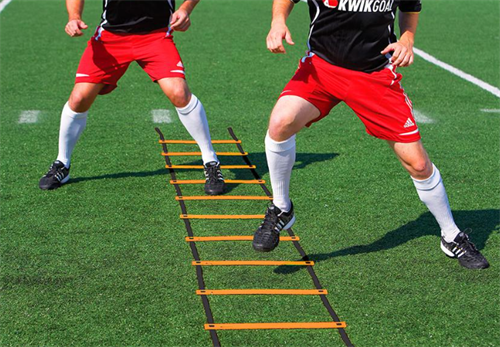
The picture is from Goal Kick Soccer , the copyright belongs to the original author
Representative Ladder Drills:
Below are several effective ladder drills designed to enhance coordination, agility, and explosive power. Each exercise targets specific aspects of movement frequency, reaction speed, and overall athletic performance.
1. Fast Toe Taps (Forward Movement)
How to perform:
Lower your center of gravity and stand with one foot slightly in front of the other, heels slightly raised. Quickly alternate both feet inside each square, maintaining small, rapid steps while swinging your arms naturally to match your rhythm.
Training tips:
Keep your body facing the ladder, step twice in each square, and maintain coordination between your hands and feet. Prioritize rhythm and quickness.
2. Crossover Hops (Forward Movement)
How to perform:
Stand facing the ladder with feet apart. Jump forward so that both feet land inside two adjacent squares, then jump again to land outside the squares. On the next jump, cross your legs in midair, alternating left and right as you progress.
Training tips:
Keep jumps low to maintain speed. Land lightly with bent knees, using your arms for balance.
3. Lateral Quick Steps
How to perform:
Stand facing the ladder with feet shoulder-width apart, just outside the first square. Step your right foot into the square first, followed by the left. Then step out to the right and left sides. Continue in this pattern through the ladder.
Training tips:
Use quick, light steps. Keep your knees slightly bent and move from your arches for speed and control.
4. Lateral Cross Steps
How to perform:
Stand sideways next to the ladder. One foot starts inside the square, the other outside. Step both feet into the same square in a cross pattern, then move sideways to the next square.
Training tips:
Keep your movements quick and your center of gravity low. Avoid touching the ladder frame.
5. Hip-Twist Jumps
How to perform:
Stand with feet staggered—right foot forward—beside the ladder. Jump up, quickly rotating your hips so your feet switch positions before landing in the next square.
Training tips:
Perform quick hip rotations in midair. Land softly with bent knees to absorb impact and maintain momentum.
6. Lateral Scissor Steps
How to perform:
Stand sideways to the ladder, feet parallel. Step your front foot across your body into the square, followed by the back foot into the next square. Continue alternating this cross-step pattern to the end.
Training tips:
Keep your center of gravity low and steps quick. Ensure both feet touch each square before moving on.
7. Crossover Run (Forward)
How to perform:
Stand facing the ladder, feet slightly to the right. Step your left foot into the first square, right foot outside to the right. Shift your weight quickly, step forward, and repeat.
Training tips:
Move fluidly and maintain rhythm. Keep your torso stable and body low for balance.
8. Alternating Single-Leg Hops
How to perform:
Start facing the ladder with both feet in the first square. Jump to the right side, landing on your right foot while tucking your left leg. Next, jump back into the next square on both feet, then land on the left foot on the other side.
Training tips:
Maintain rhythm and balance. Coordinate arm swings with your jumps to support control and momentum.
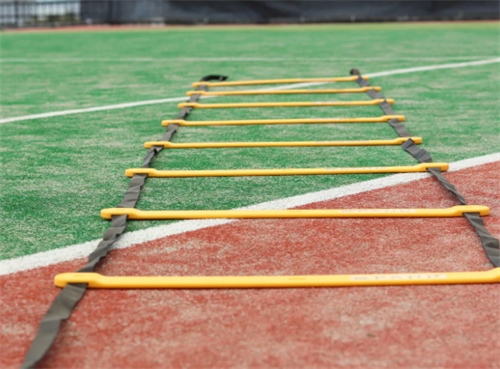
The picture is from XPAND , the copyright belongs to the original author
Training Guidelines and Safety Tips:
1. Combine Agility with Other Fitness Qualities
Agility training should be integrated with other physical conditioning goals. Define clear movement distances and completion times to increase difficulty and better stimulate the nervous system, improving both reaction speed and coordination.
2. Maintain an Active Nervous State
Agility drills are most effective when performed in a state of alertness. For best results, do them early in a workout or as part of your warm-up. Keep exercises fun and engaging to maintain motivation and focus.
3. Control Intensity and Volume
Keep ladder drills at a moderately high intensity but limit total duration. The ladder should be no longer than 15 meters, with each session lasting around 20 minutes and consisting of 2–3 sets. Avoid excessive variation—choose no more than five types of drills to maintain focus and effectiveness.
Best Practices for Daily Training:
Warm Up Thoroughly – Activate your joints and muscles before each session to prevent injury.
Keep Sessions Short – Limit each workout to 15–20 minutes, 2–3 times per week.
Integrate with Sport-Specific Skills – Combine ladder drills with sport movements such as passing, shooting, or sprinting for practical application.
Train Individually – The agility ladder is compact and portable, perfect for solo training in small spaces like home gyms or garages3.
Risk Management:
For ankle injuries: Wear figure-eight ankle wraps to restrict inversion and eversion to less than 10°.
If plantar fascia pain occurs: Reduce session duration to 8 minutes.
Use safe equipment: Choose ladders with a slip resistance rating of ≥0.8 to prevent falls and sprains.
For hypertension: Avoid sprinting for longer than 30 seconds continuously; keep your heart rate below (220 – age) × 0.85.
Scientific Evidence:
According to research from the University of Cambridge Centre for Sports Neuroscience, performing agility ladder training four times per week for 12 minutes each session (30 seconds sprint / 30 seconds rest intervals) improved reaction speed by 19% and ankle stability by 33%. This improvement results from the ladder’s multidirectional footwork, which stimulates the cerebellum–basal ganglia circuit, enhancing neuromuscular precision and information-processing efficiency.
[Disclaimer: The content of this article is for fitness and health reference only and does not constitute medical advice. Please consult a qualified physician or certified trainer before starting any exercise or nutrition program.]
Reference:
1. https://plt4m.com/blog/do-agility-ladders-work/
2. https://www.garagegymreviews.com/agility-ladder-workout
3.https://www.blazepod.com/blogs/all/agility-ladder-drills?srsltid=AfmBOoq9xIuVOGMlvNw6Xumx2Q7GJ84HiHCw_FMJzBYYg964GGf_G5v0
